Divine Tension: Embracing the Fullness of God’s Truth (Part 2)
In Part 1 we explored how divine tension is woven into the fabric of creation and Scripture, holding opposing truths together to reveal the fullness of God’s wisdom. From the balances in the physical world to core doctrines like faith and deeds, justice and mercy, we saw that embracing these tensions guards us against imbalance and draws us deeper into God’s character. As promised, let’s now apply this lens to the wisdom literature of the Old Testament: Proverbs, Ecclesiastes, and Job. These books present a striking divine tension that reflects the complexities of life under the sun while pointing us to eternal truths.
At first glance, these books might seem to contradict one another. Proverbs tells us the world we live in operates under a moral divine order, with clear spiritual principles for living wisely, while Ecclesiastes paints a picture of randomness, futility and unpredictability. Job plunges us into the depths of undeserved suffering and chaos. Yet, when held in tension, they provide a balanced, profound understanding of God’s world: orderly yet disrupted, purposeful yet mysterious.
The orderly world of Proverbs
Proverbs stands as a beacon of divine wisdom, guiding us toward a life of blessing through righteous choices and disciplined living. It portrays a world governed by moral laws where actions have predictable consequences. A brief look at just four topics paints a clear picture.
Consider the theme of wealth. Proverbs 13:11 warns, “Wealth gained hastily will dwindle, but whoever gathers little by little will increase it.” This teaches the value of patience and steady effort over get-rich-quick schemes. Similarly, Proverbs 21:20 notes, “Precious treasure and oil are in a wise man’s dwelling, but a foolish man devours it,” encouraging prudent management and living within one’s means.
In work, diligence is exalted: “The hand of the diligent will rule, while the slothful will be put to forced labor” – Proverbs 12:24, and “In all toil there is profit, but mere talk tends only to poverty” – Proverbs 14:23. Hard work leads to prosperity; laziness to hardship.
Relationships thrive on sharpening and counsel: “Iron sharpens iron, and one man sharpens another” – Proverbs 27:17, acknowledging that growth often involves challenge. Proverbs 15:22 advises, “Without counsel plans fail, but with many advisers they succeed,” urging us to seek wise input rather than act impulsively.
Finally, in choices, we’re called to trust God and his wisdom to guide us: “Trust in the Lord with all your heart, and do not lean on your own understanding” – Proverbs 3:5-6, and “Commit your work to the Lord, and your plans will be established” – Proverbs 16:3.
The overarching message of Proverbs is clear: Righteous living leads to blessings and success; unrighteous living to failure and pain. The world operates under moral order—obey God’s principles, and life flourishes. Our lives have purpose when aligned with his ways.
The futility of Ecclesiastes
Yet Solomon, the primary author of Proverbs, takes a surprisingly different tone in Ecclesiastes. Here, the same wise teacher observes life “under the sun” and concludes it is often “meaningless—like chasing the wind” – Ecclesiastes 1:14. The moral order in Proverbs now appears random and unpredictable.
Ecclesiastes 1:13-15 describes the human race enduring a “tragic existence,” where “what is wrong cannot be made right. What is missing cannot be recovered.” Later, in Ecclesiastes 9:11: “The race is not to the swift or the battle to the strong, nor does food come to the wise or wealth to the brilliant or favor to the learned; but time and chance happen to them all.” Efforts don’t always yield expected results. Success isn’t guaranteed by ability or righteousness; randomness and frustration abound.
Have you ever felt that life’s outcomes defy logic? Ecclesiastes captures that cynicism, highlighting the vanity and unpredictability that can overshadow even wise living. How can the writer of Proverbs be the same person who wrote Ecclesiastes?
The chaos agent in Job
Job introduces yet another layer: innocent suffering. Job is described as “blameless and upright, a man who feared God and shunned evil” – Job 1:1. He was prosperous and devout. He believed in the moral principles of Proverbs and followed them devoutly. In the book of Job God peels back the curtain and introduces us to the ultimate chaos agent, Satan. He challenges God, accusing Job of serving him only for blessings. God permits testing, and Job’s ordered life shatters, his livestock is stolen, servants are killed, and tragically his children lost in a storm.
How does Job respond? Not with blame, but worship: “The Lord gave me what I had, and the Lord has taken it away. Praise the name of the Lord!” – Job 1:21. Remarkable faith.
Job’s three friends, steeped in a Proverbs-like worldview, assume he must be at fault. A + B = C. In chapters four through 25 (a full 22 chapters) they argued that his suffering must be punishment for sin, but they were wrong. The book reveals the agent disrupting God’s order. Yet God remains sovereign, ultimately restoring Job’s health, wealth, family, and dignity. As Romans 8:28 echoes, “In all things God works for the good of those who love him.”
Integrating the wisdom literature: divine tension in action
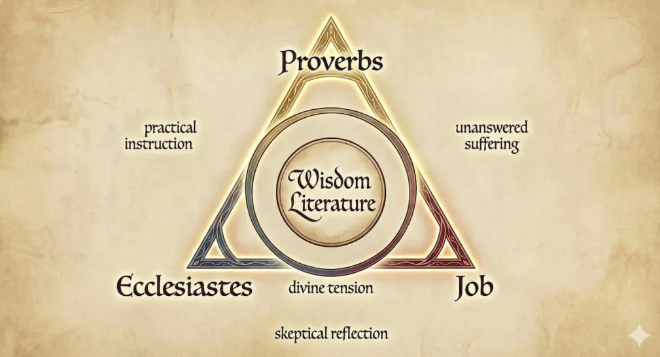
Herein lies the profound divine tension of the wisdom books:
- Proverbs affirms God’s created order: Moral laws govern life, righteousness brings blessing.
- Ecclesiastes and Job acknowledge disruption: Sin and Satan introduce chaos, unpredictability, and suffering, even for the righteous.
But the tension doesn’t end in despair! God, in his sovereignty, restores order over time for those who remain faithful. Justice prevails in the long run; meaning emerges when we fear God and keep his commandments (Ecclesiastes 12:13).
This both/and perspective prevents extremes. Overemphasizing Proverbs alone might breed a prosperity mindset, ignoring life’s hardships. Leaning solely on Ecclesiastes could lead to cynicism and resignation. Job reminds us that suffering isn’t always punitive, yet God redeems it.
Embracing this tension brings balance: Live wisely as in Proverbs, endure chaos with Job’s faith, and maintain perspective amid vanity as in Ecclesiastes. The fullness of wisdom, and of God’s truth, emerges only when we hold all three together.
Conclusion and application
The wisdom literature mirrors the divine tensions we’ve seen elsewhere in Scripture: order and disruption, justice delayed yet certain, purpose amid apparent meaninglessness. By integrating these books, we gain borders for navigating life, avoiding naivety on one side and hopelessness on the other. Holding the tension honors God’s multifaceted revelation and equips us for real-world faith.
For reflection:
- How have you experienced the tension between an “orderly” expectation of life and its chaotic realities?
- In what area might you be overemphasizing one wisdom book’s perspective, leading to imbalance?
May this divine tension draw us closer to the God who designed a world of profound depth, where opposites coexist in perfect harmony under his sovereign hand.
| Tension in wisdom literature | Scripture focus | Imbalance risks |
|---|---|---|
| Order / chaos | Proverbs (moral laws) vs. Ecclesiastes/Job (unpredictability, suffering) | Prosperity gospel or despairing cynicism |
| Righteousness leads to blessing / time and chance disrupt outcomes | Proverbs 13:11; Ecclesiastes 9:11 | Blaming victims or fatalism |
| Human effort and wisdom / divine sovereignty and restoration | Proverbs 3:5-6; Job 42 (restoration); Romans 8:28 | Self-reliance or passivity |
Watch the related sermon for more insights on this series.