Offering more than only medical help – Dr Elijah Nkosi's story

March 31, 2022

#ThrowbackThursday: this story was shared in June 2020

In South Africa, a country that has yet to reach the peak of COVID-19 infections, and with a population that has HIV, diabetes and other chronic illnesses to factor in, people sometimes need more than just medical help. Ministering to his patients in a holistic way, is something that this Johannesburg doctor has learned early on in his walk as a disciple of Jesus. This is his story:


My name is Elijah Nkosi. I am 59 years old, a medical doctor in private practice and a member of the Johannesburg Church of Christ (JCOC). My wife Valerie and I have been married since 1992, and we’ve been blessed with three lovely children. We have two other children from previous relationships that I had before we got married. 


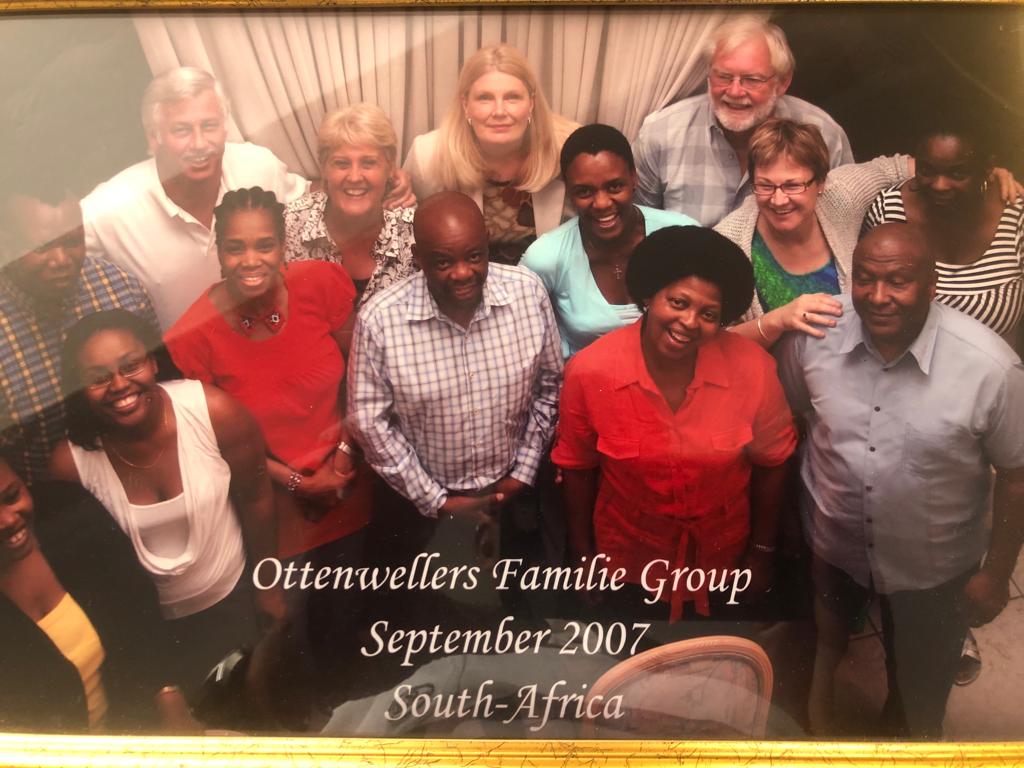
We were met by Jack Ingle, then a member of the church in Johannesburg, on my wife Valerie’s birthday in December 2004. We were visiting a wine farm while on holiday in Cape Town, when Jack invited us to church, and on our return to Johannesburg, we went and enjoyed the message and the fellowship. I studied the Bible with Dr Mark Ottenweller (during his time in South Africa) and Valerie and I joined his family group. We were subsequently baptized a few months later in 2005. We are very thankful to the late Baba Eugene Malao and his wife Tshidi, who were instrumental in our conversion.


In our family group meetings and my study sessions with Dr Mark, he shared about the period when he was still practising medicine, and how he would counsel patients psychologically and spiritually after he had diagnosed their medical ailment. He said that in a number of instances he would then write two scripts for these patients. One would be for the medicine that they required. The second one would be Bible verses that he shared with them to read at home. He said that seemed to make a difference in how these patients responded to him and they showed appreciation for the spiritual counsel. 


I qualified as a medical doctor in 1986 and have been in private practice in Soweto, Johannesburg, since 1990. As part of my training as a General Practitioner, I treat people who have general illnesses, that sometimes include mental challenges. These individuals might also be anxious and depressed. In some instances, they need medication to treat their ailment. But, what I realized, and it has worked quite favorably for me and these patients, is that they also need counseling. This could be psychological and/or spiritual. 


This has led to occasions where I would share scriptures such as Philippians 4: 6–7 “Rejoice in the Lord always. I will say it again: Rejoice! Let your gentleness be evident to all. The Lord is near. Do not be anxious about anything, but in every situation, by prayer and petition, with thanksgiving, present your requests to God”; and Matthew 11: 28–29 “Come to me, all who labor and are heavy laden, and I will give you rest. Take my yoke upon you, and learn from me, for I am gentle and lowly in heart, and you will find rest for your souls”; and Matthew 6: 21–34 that deals with where your treasure is.


During those discussions and sharing, I would see the mood of these individuals change. Some would smile and open up about their challenges, and show appreciation for the biblical message that I'd be haring. I would then write these scriptures on a piece of paper and give it to them together with their prescription for medicine. 


These experiences have made me realize that we can serve God in many different ways. It shows that many people are hurting and require spiritual support; and that we can reach out to them. Most of my patients know that I am a Christian and at times they would come to me and ask for scriptures and spiritual guidance. I thank God for putting me in this position that allows me to serve Him in this particular way. To God be the glory. Amen! 

#mystory

By Justin Renton August 4, 2026
In the messy arena of human relationships, whether in marriage, the workplace, church family, or the volatile world of online discourse, we constantly feel the pull of opposing forces. One voice urges us to defend truth fiercely; another calls us to extend grace generously. This is the divine tension of disagreement: holding both conviction and compassion without letting go of either. Today, we turn to a passage that cuts to the heart of how we handle differences: “My dear brothers and sisters, take note of this: Everyone should be quick to listen, slow to speak and slow to become angry, because human anger does not produce the righteousness that God desires.” – James 1:19-20 (NIV) James, writing to scattered believers across the nations, doesn’t offer fluffy advice. He gives a practical, counter-cultural blueprint for godly relationships: Be quick to listen. Slow to speak. Slow to anger. These aren’t suggestions for better conversations; they are directives for producing the righteousness God desires. This passage applies to husbands and wives, children and parents, bosses and workers; everyone from the pulpit to the pew. We all need to train ourselves to be better listeners. The divine tension in James’ command Here lies the tension: Listening requires humility and self-control, while speaking (especially in defense of truth) feels urgent. Anger can arise when we perceive injustice or error, yet James holds these in balance. We must lean into listening first, restrain our tongues, and guard our hearts against hasty wrath. Why? Because “human anger does not produce the righteousness that God desires.” This isn’t a ban on all anger; Jesus displayed righteous anger in the temple (John 2:13-17). But human anger, tainted by our flesh, tends toward self-justification, escalation, and sin. It rarely births the fruit of the Spirit. The tension calls us to slow down enough for the Holy Spirit to lead, rather than our adrenaline. What science reveals about anger and “hearing” Modern neuroscience echoes what James knew by inspiration. When anger flares, our brain undergoes an “amygdala hijack.” The amygdala, the brain’s alarm system tied to fight-or-flight, floods the body with adrenaline and cortisol. This redirects resources: our heart rate spikes and oxygen flows to muscles for action, but our higher reasoning centers in the prefrontal cortex – responsible for judgment, empathy, and nuanced thinking – get suppressed. In this state, our ability to truly “hear” another person diminishes dramatically. Active listening, the tool that clarifies, disarms, and seeks understanding, becomes nearly impossible. We filter everything through threat detection, empathy drops, and we stop processing the other’s words for their actual meaning. Instead, while they are still speaking we start crafting rebuttals or counterattacks. This explains why conflicts escalate so quickly: we literally cannot hear well when flooded with anger. James’ call to be slow to anger is not just spiritual wisdom; it aligns with how God designed our brains to function best when governed by self-control rather than unchecked emotion. Recognizing our physiological limits isn’t about suppressing feelings, it’s about guarding our capacity for reason so we don’t accidentally sabotage the very justice we seek to defend. Even if the other person is operating out of a completely hijacked, high-emotion state, our calling to maintain self-control and clear thinking remains. When our prefrontal cortex goes offline, our hijacked brain defaults to intellectual shortcuts. This emotional flooding is precisely what predisposes us toward constructing caricatures, like the straw man, rather than engaging with the actual person.
By Justin Renton July 9, 2026
On June 6, 1944, Allied forces stormed the beaches of Normandy. In the brutal hours that followed, the course of World War II shifted permanently. The enemy’s capacity to win had been broken. And yet, the fighting raged on for 11 more months. Soldiers still died; cities still burned. Berlin had not yet fallen. But every Allied commander knew the truth: what happened on D-Day determined what would happen on V-E Day (Victory in Europe Day). Victory was certain, even though it was not yet complete. Through his death and resurrection, Jesus Christ stormed the ultimate beach. The decisive battle against sin, death, and darkness has already been won. And yet, we are not yet living in the full experience of that victory. The war is over, and the war is still going. Not because the outcome is in doubt, but because we live between D-Day and V-E Day. This pattern – already won, not yet complete – is the “already but not yet,” and it is not a contradiction. It is the very fabric of the Christian life. As we’ve seen across this series, the fullness of God’s truth is rarely found in tidy, isolated categories. It is held in divine tension, where seemingly opposing realities coexist, each completing and guarding the other. And nowhere is that tension more vivid than in what Scripture says about our own salvation. The Biblical paradox The New Testament speaks of our adoption, redemption, salvation, sanctification, and resurrection in a way that constantly surprises us: as both accomplished facts and future hopes. This is not a theological error; it is the deliberate structure of a story that is already finished by the Author but still being written by the characters. Adoption Already: “You have received the Spirit of adoption as sons, by whom we cry, ‘Abba! Father!’” – Romans 8:15 Not yet: “We ourselves groan inwardly as we wait eagerly for adoption as sons, the redemption of our bodies.” – Romans 8:23 Redemption Already: “In him we have redemption through his blood, the forgiveness of sins.” – Ephesians 1:7 Not yet: “You were sealed for the day of redemption.” – Ephesians 4:30 Salvation Already: “For it is by grace you have been saved, through faith.” – Ephesians 2:8 Not yet: “How much more shall we be saved from God’s wrath through him!” – Romans 5:9 Sanctification and resurrection Already: We are already sanctified in Christ and raised with him. – 1 Corinthians 1:2 and Ephesians 2:6 Not yet: We await final sanctification and the future resurrection of the dead at the last trumpet. – 1 Thessalonians 5:23–24 and 1 Corinthians 15:52 The same salvation is being described as past, present, and future. We have been saved. We are being saved. We will be saved. This is not a contradiction, it is the both/and of divine tension. Understanding the timeline To make sense of this, we need to understand how Scripture structures history. Jewish thought divided all of time into two ages: “This age” — the present age marked by sin, suffering, and death — and “the age to come,” when God would restore all things, defeat evil, and reign in fullness. The expectation was that these two ages would be strictly sequential: this age ends, the next one begins. What no one fully anticipated was that through the resurrection of Jesus and the outpouring of the Holy Spirit, the “age to come” broke into “this age” before it was over. We now live in what theologians call “the age between the ages.” The Kingdom of God has arrived, and it is still arriving.
June 21, 2026
The perfect Father chooses mercy over judgment and connection over correction, and he celebrates repentance, calling us to reflect His love and grace.
Show More