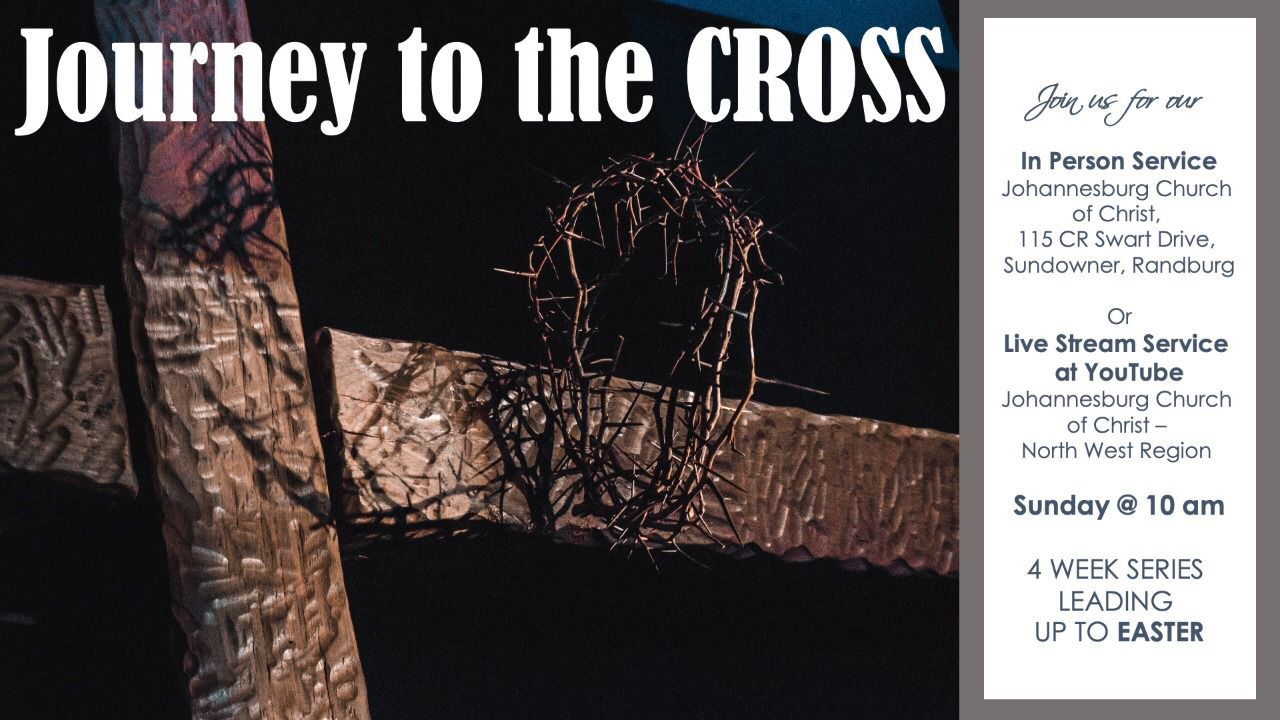
Journey to the Cross, Part 3—Dave Jacobs

April 10, 2022

Sermon summary:

The Arrest (Matthew 26:47-56): 

Jesus' character and moral toughness in his arrest. It's an aspect of Jesus' character that so many seem to have forgotten. 


It is here at the arrest that we begin to see the incredible strength and restraint of our Lord. His righteousness at his arrest is simply amazing. When others disappointed him and let him down, he stood firm. When others turned on him and betrayed him, he was righteous. We all know the pain of being lied to or mistreated. It hurts. Yet Jesus shows us the way in loving our enemies in His response to Judas. He was full of grace in His response to Judas and called Him ‘friend’. Judas treated Jesus so cowardly, and Jesus was still willing to call him his friend. This is grace beyond measure. 


Jesus does make a comment to the crowd. He cuts right to the issue at hand. V55 "Am I leading a rebellion, that you have come out with swords and clubs to capture me? Every day I sat in the temple courts teaching, and you did not arrest me." 


His was a simple question that he might ask some of us today. Why do you act one way at the temple and another when you are elsewhere? Are you someone who pays lip service to Jesus at religious services, but betrays him in the darkness later? 


But Jesus was going to Calvary voluntarily. His love compelled Him to make the sacrifice that would save our souls. Despite the ability to free himself and punish the offenders, He freely gave himself up for all of us. Jesus walked into this knowing exactly what was in store for him. That's how much he loved us. 


Before the High Priest (Matthew 26:57-68) 

It must have seemed so simple to Caiaphas before the trial began. False witnesses would testify. A verdict would be reached. Legal traditions would be ignored while Jerusalem slept. Jesus would be hustled off to Pilate for an early morning sentencing.  You can sense the frustration building as Caiaphas struggled to find a charge that would stick. 


Jesus remained silent. His silence seemed to frustrate the High Priest all the more. V62 "Aren't you going to answer?" Caiaphas asked. "What is this testimony that these men are bringing against you?" 


Silence would have saved Jesus' life at this point, and he knew it. If he had held his tongue, he might possibly have gotten off with a beating or less. Jesus, however, knew exactly what he was doing. His silence, confession, and submission to these hypocrites were crucial to the completion of his mission. He took that step voluntarily. It was a big step on the road to Calvary. 


Once you understand that He did this because he loves you personally, then you, too, are ready to take his hand and walk that road to the Cross with Him. 


Following at a Distance, Then Denial (Matthew 26:69-75) 


Denial: This a familiar passage to most of us. Peter denying Jesus Christ 3 times. Fear took over when Peter was questioned about Him being a follower of Jesus. His boasting of faith and courage was being replaced with a display of cowardice and weakness. 


Why did Peter come to a place of weakness and denying Jesus Christ? We’ve seen already how he slept too much and prayed too little in the Garden of Gethsemane. Yet There is more… 


Peter in the courtyard of Caiaphas’ house was a far different Peter than had eaten the last supper with Jesus. Bold and confident over dinner, Peter was a man who was ready to change the world. By the time he reached the high priest’s home, things had changed. Now he was a spectator. He didn’t try to effect the trial. Instead, he “entered and sat down to see the outcome.” How out of character for Peter. He had stepped off the playing field and sat down in the grandstands to watch. Fear was at work in his heart. 


You notice this especially in the way Peter moved around the courtyard. First he tried to fit in with the guards. When his accent gave him away, he slunked over to a dark spot near the gate. He didn’t want to stand out. He wanted to fit in. He felt most comfortable hidden in the darkness. He was keeping his distance. Peter had changed from pro-active to inactive. 


Some may be following Jesus at a distance today. This timid and cowardly approach to discipleship often seems safe and comfortable. Yet distance can be dangerous. If we keep our distance from Jesus, it could mean pretty soon you may be really not a follower at all. 


Distance means being full of unconfessed sin. It means quiet doubts of God & the Bible. 


Do you find yourself following at a distance today? Have you come off the playing field and taken a comfortable seat in the grandstands? 


Our aim as disciples is to let our light shine on earth so that people can see who we are. 


Conclusion:

*To be tough like Jesus and show strength and restraint as we face the challenges of life. To be full of grace when let down by others and to love our enemies as Jesus Christ showed in His response to Judas.

*To not follow Jesus at a distance. 


Watch the full sermon here.

By Justin Renton August 4, 2026
In the messy arena of human relationships, whether in marriage, the workplace, church family, or the volatile world of online discourse, we constantly feel the pull of opposing forces. One voice urges us to defend truth fiercely; another calls us to extend grace generously. This is the divine tension of disagreement: holding both conviction and compassion without letting go of either. Today, we turn to a passage that cuts to the heart of how we handle differences: “My dear brothers and sisters, take note of this: Everyone should be quick to listen, slow to speak and slow to become angry, because human anger does not produce the righteousness that God desires.” – James 1:19-20 (NIV) James, writing to scattered believers across the nations, doesn’t offer fluffy advice. He gives a practical, counter-cultural blueprint for godly relationships: Be quick to listen. Slow to speak. Slow to anger. These aren’t suggestions for better conversations; they are directives for producing the righteousness God desires. This passage applies to husbands and wives, children and parents, bosses and workers; everyone from the pulpit to the pew. We all need to train ourselves to be better listeners. The divine tension in James’ command Here lies the tension: Listening requires humility and self-control, while speaking (especially in defense of truth) feels urgent. Anger can arise when we perceive injustice or error, yet James holds these in balance. We must lean into listening first, restrain our tongues, and guard our hearts against hasty wrath. Why? Because “human anger does not produce the righteousness that God desires.” This isn’t a ban on all anger; Jesus displayed righteous anger in the temple (John 2:13-17). But human anger, tainted by our flesh, tends toward self-justification, escalation, and sin. It rarely births the fruit of the Spirit. The tension calls us to slow down enough for the Holy Spirit to lead, rather than our adrenaline. What science reveals about anger and “hearing” Modern neuroscience echoes what James knew by inspiration. When anger flares, our brain undergoes an “amygdala hijack.” The amygdala, the brain’s alarm system tied to fight-or-flight, floods the body with adrenaline and cortisol. This redirects resources: our heart rate spikes and oxygen flows to muscles for action, but our higher reasoning centers in the prefrontal cortex – responsible for judgment, empathy, and nuanced thinking – get suppressed. In this state, our ability to truly “hear” another person diminishes dramatically. Active listening, the tool that clarifies, disarms, and seeks understanding, becomes nearly impossible. We filter everything through threat detection, empathy drops, and we stop processing the other’s words for their actual meaning. Instead, while they are still speaking we start crafting rebuttals or counterattacks. This explains why conflicts escalate so quickly: we literally cannot hear well when flooded with anger. James’ call to be slow to anger is not just spiritual wisdom; it aligns with how God designed our brains to function best when governed by self-control rather than unchecked emotion. Recognizing our physiological limits isn’t about suppressing feelings, it’s about guarding our capacity for reason so we don’t accidentally sabotage the very justice we seek to defend. Even if the other person is operating out of a completely hijacked, high-emotion state, our calling to maintain self-control and clear thinking remains. When our prefrontal cortex goes offline, our hijacked brain defaults to intellectual shortcuts. This emotional flooding is precisely what predisposes us toward constructing caricatures, like the straw man, rather than engaging with the actual person.
By Justin Renton July 9, 2026
On June 6, 1944, Allied forces stormed the beaches of Normandy. In the brutal hours that followed, the course of World War II shifted permanently. The enemy’s capacity to win had been broken. And yet, the fighting raged on for 11 more months. Soldiers still died; cities still burned. Berlin had not yet fallen. But every Allied commander knew the truth: what happened on D-Day determined what would happen on V-E Day (Victory in Europe Day). Victory was certain, even though it was not yet complete. Through his death and resurrection, Jesus Christ stormed the ultimate beach. The decisive battle against sin, death, and darkness has already been won. And yet, we are not yet living in the full experience of that victory. The war is over, and the war is still going. Not because the outcome is in doubt, but because we live between D-Day and V-E Day. This pattern – already won, not yet complete – is the “already but not yet,” and it is not a contradiction. It is the very fabric of the Christian life. As we’ve seen across this series, the fullness of God’s truth is rarely found in tidy, isolated categories. It is held in divine tension, where seemingly opposing realities coexist, each completing and guarding the other. And nowhere is that tension more vivid than in what Scripture says about our own salvation. The Biblical paradox The New Testament speaks of our adoption, redemption, salvation, sanctification, and resurrection in a way that constantly surprises us: as both accomplished facts and future hopes. This is not a theological error; it is the deliberate structure of a story that is already finished by the Author but still being written by the characters. Adoption Already: “You have received the Spirit of adoption as sons, by whom we cry, ‘Abba! Father!’” – Romans 8:15 Not yet: “We ourselves groan inwardly as we wait eagerly for adoption as sons, the redemption of our bodies.” – Romans 8:23 Redemption Already: “In him we have redemption through his blood, the forgiveness of sins.” – Ephesians 1:7 Not yet: “You were sealed for the day of redemption.” – Ephesians 4:30 Salvation Already: “For it is by grace you have been saved, through faith.” – Ephesians 2:8 Not yet: “How much more shall we be saved from God’s wrath through him!” – Romans 5:9 Sanctification and resurrection Already: We are already sanctified in Christ and raised with him. – 1 Corinthians 1:2 and Ephesians 2:6 Not yet: We await final sanctification and the future resurrection of the dead at the last trumpet. – 1 Thessalonians 5:23–24 and 1 Corinthians 15:52 The same salvation is being described as past, present, and future. We have been saved. We are being saved. We will be saved. This is not a contradiction, it is the both/and of divine tension. Understanding the timeline To make sense of this, we need to understand how Scripture structures history. Jewish thought divided all of time into two ages: “This age” — the present age marked by sin, suffering, and death — and “the age to come,” when God would restore all things, defeat evil, and reign in fullness. The expectation was that these two ages would be strictly sequential: this age ends, the next one begins. What no one fully anticipated was that through the resurrection of Jesus and the outpouring of the Holy Spirit, the “age to come” broke into “this age” before it was over. We now live in what theologians call “the age between the ages.” The Kingdom of God has arrived, and it is still arriving.
June 21, 2026
The perfect Father chooses mercy over judgment and connection over correction, and he celebrates repentance, calling us to reflect His love and grace.
Show More